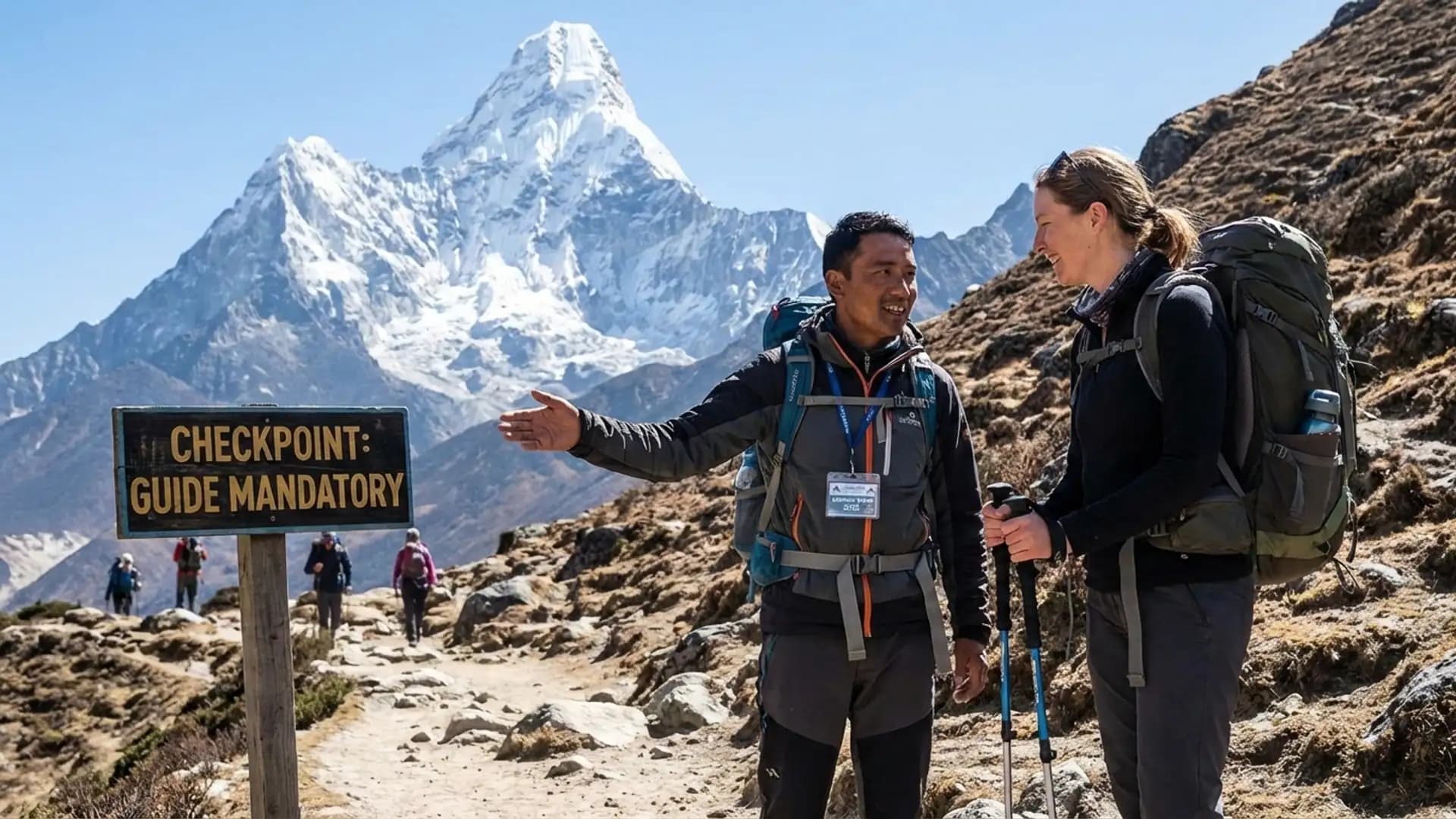
Nepal Trekking Guide Requirement 2026: Solo Permits, Digital Applications, and Everything That Changed
Updated: March 2026 Nepal's Department of Immigration issued new trekking rules on March 23, 2026. Two major things changed: solo travelers can now get restricted area permits without needing a trekking partner, and the entire permit application process has moved online. The mandatory licensed guide rule remains in full force. This article reflects all current regulations.
Quick Answer: What Are the Nepal Trekking Rules in 2026?
If you are planning a trek in Nepal and want a fast summary before reading the full guide, here it is.
You must have a licensed guide on all major trekking routes, including Everest Base Camp, Annapurna Circuit, Manaslu, Langtang, and all trails inside national parks and conservation areas. This rule has been in place since April 2023 and is strictly enforced in 2026.
You no longer need a trekking partner to access restricted areas like Upper Mustang, Upper Dolpo, and Nar-Phu Valley. Solo travelers can now apply for restricted area permits directly through a registered agency.
Permits can now be applied for online using your visa application number before you even arrive in Nepal.
Everything else stays the same: no freelance guides, no unregistered agencies, no skipping checkpoints.
Table of Contents
What Changed in March 2026
What Is the Nepal Mandatory Guide Rule?
Why Nepal Introduced This Rule
Which Treks Require a Guide in 2026?
New: Solo Permits for Restricted Areas
New: The Digital Permit Application System
Guide Costs and What Is Included
How to Choose a Licensed Guide
Your Options as a Solo Traveler
Checkpoint Rules and Penalties
Frequently Asked Questions
1. What Changed in March 2026
On March 23, 2026, Nepal's Department of Immigration announced two significant updates to trekking permit policy. These changes respond to years of feedback from the Trekking Agencies' Association of Nepal (TAAN) and independent travelers.
Change One: Solo Trekkers Can Now Access Restricted Areas
Previously, restricted area trekking permits were issued only to groups of two or more travelers. If you were a solo traveler hoping to trek Upper Mustang, Nar-Phu Valley, Upper Dolpo, or Tsum Valley, you had to find a trekking partner before you could legally apply.
That rule has been removed. Solo foreign travelers can now apply for restricted area permits individually through a registered trekking agency. You still need a licensed guide for the trek itself. What changed is that you no longer need to show up with a companion just to qualify for the permit.
This decision came directly from the Department of Immigration in response to complaints that the group requirement was discouraging solo travelers and harming Nepal's tourism industry.
Change Two: Permits Now Available Through a Digital Platform
The Department of Immigration has moved the restricted area permit system fully online. The key update for travelers planning from abroad is this: you no longer need a confirmed Nepali visa number to begin your permit application.
You can now apply using your visa Application Submission ID, which you receive when you apply for your Nepal visa. This means you can start the permit process from your home country, pay fees in advance, and arrive in Nepal with your paperwork already in order.
A dedicated helpline has also been introduced for applicants facing technical issues with the system: +977-9761423636.
What Did Not Change
Both updates apply specifically to restricted area permits. For the vast majority of popular trekking routes, the existing rules continue exactly as before.
The mandatory licensed guide rule is unchanged for all regulated routes
All guides must hold a valid Nepal Tourism Board license
All treks must be booked through a registered trekking agency
Checkpoint enforcement remains strict
Fines for trekking without a guide are unchanged
2. What Is the Nepal Mandatory Guide Rule?
The Nepal government introduced the mandatory guide regulation on April 1, 2023. By 2024 and into 2026, enforcement at all major checkpoints became strict and consistent.
The rule states: every foreign trekker on a regulated trail must be accompanied by a licensed trekking guide employed through a government-registered trekking agency.
If you are also figuring out the full cost of your trip, our Nepal trekking cost guide for 2026 breaks down every expense from permits to food to accommodation.
What "Licensed" Actually Means
A licensed guide in Nepal is not simply someone who knows the mountains. They hold a government-issued trekking guide license from the Nepal Tourism Board, have completed formal training through the Nepal Academy of Tourism and Hotel Management (NATHM) or the Trekking Agencies' Association of Nepal (TAAN), and carry valid wilderness first aid certification.
Hiring a neighbor, a local friend, or an unlicensed individual does not satisfy this requirement, even if that person knows the route well.
How the TIMS Card Changed
Before 2023, independent trekkers could walk into the Nepal Tourism Board office and purchase a Green TIMS card on their own, which gave them permission to trek solo. That option no longer exists for foreign nationals on regulated routes. You now receive a TIMS card through a registered agency, and it is linked to your guide's information.
3. Why Nepal Introduced This Rule
Understanding the reason behind this policy helps you see it as more than just bureaucratic enforcement. There are real, documented outcomes that came from it.
Fewer Rescue Operations
Before 2023, Nepal handled between 300 and 400 helicopter rescues every single year. The majority involved solo trekkers who became lost, developed altitude sickness without anyone nearby to recognize the symptoms, or pushed through dangerous weather conditions without local knowledge. After the guide requirement came into effect, rescue operations dropped by 40 percent. That is not a small number. It represents hundreds of people who reached home safely rather than requiring emergency evacuation.
Economic Impact for Mountain Communities
Tourism money historically concentrated in Kathmandu-based agencies and international operators. The guide requirement created over 10,000 licensed guiding jobs, most of them held by people from the very communities that host trekkers. Guides from Namche Bazaar, Besisahar, and Jagat now earn a professional income that keeps money inside their villages. At Adventure Life Nepal, every guide we work with is from the region they lead, so your money reaches the community directly.
Environmental Protection
Solo trekkers, through no fault of their own, tend to wander off-trail, handle waste disposal independently, and miss the cultural cues that licensed guides actively teach. With guides enforcing Leave No Trace principles, reporting illegal dumping, and steering trekkers away from fragile ecosystems, the condition of Nepal's high-altitude trails has measurably improved.
Insurance Fraud Reduction
Before 2023, fraudulent helicopter evacuation claims for fake altitude sickness were costing insurance companies millions of dollars annually. Licensed guides are trained to make professional medical assessments before calling for evacuation, and their documentation creates an official record. Fraudulent claims have dropped sharply since the rule was introduced.
4. Which Treks Require a Licensed Guide in 2026?
The short answer: nearly every trail that draws foreign visitors requires a guide. Here is the breakdown by region.
Everest Region
Every route within Sagarmatha National Park requires a licensed guide. This includes the Everest Base Camp Trek, Gokyo Lakes, the Three Passes Trek, Luxury EBC, and any variation passing through Namche Bazaar, Tengboche, or Lobuche.
Annapurna Region
All routes within the Annapurna Conservation Area require a guide. This covers Annapurna Base Camp, the Annapurna Circuit, Poon Hill, Mardi Himal, the Jomsom to Muktinath route, and the Kali Gandaki Gorge trail. If you are deciding between the two big circuits, read our comparison of Manaslu vs Annapurna Circuit to find which suits you better.
Manaslu Region
The Manaslu Circuit Trek is both a national park area and a restricted zone, so it requires a licensed guide. The adjacent Tsum Valley trek falls under the same rules.
Langtang Region
The Langtang Valley Trek, Gosaikunda, Helambu, and the Tamang Heritage Trail all require licensed guides as these routes pass through Langtang National Park.
Restricted Areas (with Updated 2026 Rules)
Upper Mustang, Upper Dolpo, Nar-Phu Valley, Tsum Valley, Kanchenjunga, and Humla all require restricted area permits in addition to a licensed guide. As of March 2026, solo travelers can now apply for these permits individually. The minimum group size requirement has been removed.
Where Guides Are Not Legally Required
Day hikes near Kathmandu and Pokhara that stay outside national park and conservation area boundaries do not require a guide. Some community-managed trails in less-visited regions also fall outside the regulated network, though these routes typically lack teahouse infrastructure. A good option in this category is the Khopra Danda Trek, which offers a quieter alternative to the main circuits.
In practical terms, if a route requires a permit (ACAP, SNP, MCAP, or a restricted area permit), it also requires a licensed guide.
5. New in 2026: Solo Permits for Restricted Areas
This is the most significant rule change for independent travelers.
What Restricted Areas Are We Talking About?
Nepal's restricted areas are regions that border Tibet or contain highly sensitive cultural and ecological environments. They require a special permit from the Department of Immigration, separate from the standard conservation area permits. The new solo permit rule applies across 13 designated districts in these zones, including the most popular restricted routes.
Upper Mustang sits along the Tibetan plateau border, known for its ancient walled city of Lo Manthang, cave monasteries, and desert-like terrain that looks nothing like the rest of Nepal. See our Upper Mustang tour for full itinerary details.
Nar-Phu Valley lies hidden behind the Annapurna massif. Very few trekkers go here, and the villages feel genuinely untouched by modern tourism.
Upper Dolpo is one of the most remote trekking regions on earth. Long days of walking, almost no other trekkers, and scenery that feels wild and unfamiliar even by Himalayan standards.
Tsum Valley is a sacred Buddhist pilgrimage valley with monasteries, mani walls, and a stillness that experienced trekkers describe as unlike anywhere else.
What Exactly Changed
Before March 23, 2026, you needed at least one trekking companion to apply for a restricted area permit. You could not go as a single person. If you could not find a partner in time, you had to cancel or postpone. TAAN had been lobbying against this policy for years, arguing it was turning away a significant segment of high-value independent travelers.
The Department of Immigration agreed and removed the group requirement. You can now apply as an individual.
What Did Not Change
You still need to apply through a registered trekking agency. A licensed guide must accompany you for the entire trek. The agency takes full legal responsibility for emergency rescue and logistics. The guide-to-trekker ratio for restricted area groups is capped at one guide for every seven trekkers.
Why This Matters for Your Planning
If you had previously shelved a dream of trekking Upper Mustang because you could not find someone to go with, that obstacle is now gone. Get in touch with our team and we will handle the restricted area permit, guide arrangement, and itinerary planning for you.
6. New in 2026: The Digital Permit Application System
Nepal's restricted area permit applications have moved to a fully online platform. This is a meaningful upgrade for international travelers.
The Visa Number Problem (Now Solved)
Under the old system, your permit application required a confirmed Nepal visa number. Many travelers apply for their visa months before their trek, and if it had not been processed yet, or if you planned to get a visa on arrival, you could not start the permit application until you were physically in Nepal. This created last-minute rushes in Kathmandu and made advance planning difficult.
Under the new system, foreign trekkers can use their visa Application Submission ID (the reference number you receive when you submit your Nepal visa application) to begin the permit process. You can pay permit fees in advance and arrive in Nepal with your documentation already complete.
How the Online System Works
Your registered trekking agency will guide you through the full process. The general steps are:
Contact a registered trekking agency and confirm your route and dates
The agency submits your permit application through the Department of Immigration's online platform
You provide your visa Application Submission ID (or confirmed visa number if you already have it)
Fees are paid online
Your permit is issued digitally
Bring both digital and printed copies to all checkpoints, as some remote areas may have limited connectivity
If you experience technical difficulties, the Department of Immigration's dedicated helpline is +977-9761423636.
Contact Adventure Life Nepal if you want us to manage the full permit application process on your behalf.
7. Guide Costs and What Is Included
Guide fees in Nepal vary based on trek difficulty, guide experience, and whether you book a full package or arrange the guide independently. For a complete breakdown of everything you will spend on a Nepal trek, see our Nepal trekking cost guide for 2026.
Daily Rate Ranges in 2026
Trek Type | Budget Guide | Standard Guide | Expert Guide |
|---|---|---|---|
Everest Base Camp | $25 to $30/day | $30 to $35/day | $50+/day |
Annapurna Circuit | $25 to $30/day | $30 to $35/day | $45+/day |
Manaslu Circuit | $30 to $35/day | $35 to $40/day | $55+/day |
Upper Mustang | $35 to $40/day | $40 to $45/day | $60+/day |
Poon Hill and Easy Treks | $20 to $25/day | $25 to $30/day | $40+/day |
What Your Guide Fee Covers
Your guide fee pays for their time, navigation, translation, cultural commentary, emergency coordination, and accommodation (they stay at the same teahouses you use). You separately cover their meals, which typically adds $15 to $25 per day to your total.
Your guide will also handle checkpoint paperwork, communicate with teahouse owners on your behalf, and manage logistics if anything goes wrong.
All-Inclusive Package vs. Guide-Only Booking
All-inclusive packages bundle the guide, permits, accommodation, and meals. For Everest Base Camp, expect to pay $1,400 to $2,200 total. For first-time trekkers or anyone who prefers a stress-free experience, this is the most practical option. Browse our full range of trekking packages to find the right fit.
Guide-only booking means you pay guide fees separately and arrange permits, accommodation, and meals independently. Total costs for Everest Base Camp typically land between $900 and $1,400. This works well for experienced trekkers who want more flexibility. Request a custom quote and we will put together a guide-only arrangement based on your route and dates.
8. How to Choose a Licensed Guide
Not all guides are equal, and the difference between a great guide and a poor one can define your entire trek.
What Credentials to Look For
A qualified guide carries a government-issued Nepal Tourism Board trekking license with a unique license number. You can verify this number at nepaltraderegistrar.gov.np before you book. They should also hold current wilderness first aid certification (Wilderness First Responder or Wilderness First Aid minimum), proof of training from NATHM or TAAN, and a letter confirming employment with a registered agency.
Ask to see these documents. A professional guide will have them ready without hesitation.
Questions to Ask Before You Book
Before confirming a guide, ask how many times they have completed your specific route, what their emergency evacuation experience looks like, how they handle early altitude sickness symptoms, and how they adapt to different trekking paces. If you value solitude during trekking hours, ask whether they are comfortable giving you quiet time on the trail while remaining available for safety and logistics.
At Adventure Life Nepal, you can request a guide profile before committing. We share experience records, previous client feedback, and first aid certification details upfront.
Red Flags to Watch For
Avoid anyone who cannot produce a license number immediately, quotes rates significantly below the market standard, claims to operate without agency backing, or cannot communicate clearly in a shared language.
9. Your Options as a Solo Traveler
Being a solo traveler no longer means being excluded from Nepal's most spectacular routes. Here is how to approach your trip based on your priorities.
Option One: Private Guide, Just You
Hire a guide exclusively for yourself. You trek at your own pace, adjust the itinerary when you want, and have the mountains largely to yourself. The guide is there for safety, logistics, and cultural context, and most experienced guides understand when a traveler wants quiet.
Cost addition: Roughly $40 to $75 per day on top of your personal expenses, or $480 to $900 extra for a 12-day trek.
Request a private guide arrangement through our team and we will match you with the right person for your route and style.
Option Two: Join a Small Group Trek
Book through an agency that matches solo travelers into small groups of two to six people. You share the guide cost while still meeting like-minded travelers.
Cost addition: Roughly $5 to $12 per person per day in guide fees, depending on group size.
Browse our group trekking packages to see upcoming departure dates.
Option Three: Find a Trek Partner Independently
Connect with another solo traveler through Kathmandu guesthouses, Nepal trekking Facebook groups, or forums like Lonely Planet's Thorn Tree. Share a private guide and split the cost.
Cost addition: Roughly $13 to $25 per person per day.
This works well if budget matters and you do not mind some social coordination before your trek begins.
10. Checkpoint Rules and Penalties
Nepal's enforcement of the guide requirement is not theoretical. Checkpoints on all major routes actively verify guide credentials and trekker permits.
What Happens at Checkpoints
At each checkpoint, your guide presents their Nepal Tourism Board license and your permits are scanned or recorded. Checkpoint officers in 2026 are trained specifically to identify license irregularities and to distinguish licensed guides from unlicensed companions.
Penalties for Trekking Without a Guide
First offense: Fine of NPR 10,000 (approximately $75 USD), permit confiscation, and forced return to the last checkpoint.
Second offense: Fine of NPR 20,000 (approximately $150 USD), potential trek ban, and possible legal proceedings.
Attempting to bypass checkpoints via unofficial paths carries its own risks beyond the legal ones, including no safety net in remote terrain.
Who Is Exempt
Nepali citizens and foreign nationals holding valid Nepali permanent residence permits are exempt from the guide requirement. There are no exemptions for foreign tourists based on experience level, previous trekking history, or any other personal circumstance.
11. Frequently Asked Questions
Do I need a guide for Everest Base Camp in 2026? Yes. All routes within Sagarmatha National Park, including the Everest Base Camp Trek, require a licensed guide employed through a registered agency. There are no exceptions for foreign nationals.
Can I now trek Upper Mustang alone in 2026? You can now apply for a restricted area permit as a solo individual, which was not possible before March 2026. However, a licensed guide must still accompany you throughout the trek. See our Upper Mustang tour for full details on what the route involves.
How do I apply for a Nepal restricted area permit from home? Your registered trekking agency handles the application. You provide your visa Application Submission ID and the agency submits the paperwork through the Department of Immigration's online platform. Fees can be paid in advance. Contact us and we will manage this entire process for you.
What is the guide-to-trekker ratio for restricted areas? One guide can lead a maximum of seven trekkers in restricted area zones. This was introduced alongside the solo permit rule to maintain safety standards.
How do I verify my guide's license is real? Ask for the guide's Nepal Tourism Board license number and verify it at Department of Tourism You can also ask to see their physical ID card and first aid certification before your trek begins.
What happens if I trek without a guide and get caught? You will face a fine of NPR 10,000 on your first offense, have your permit confiscated, and be turned back at the checkpoint. Repeat offenses carry heavier fines and potential trekking bans.
Is the TIMS card still required in 2026? TIMS requirements vary by region. For restricted areas, you typically use the restricted area permit instead of a TIMS card. For routes like the Annapurna Circuit, a TIMS card may still be required. Confirm with your agency based on your specific route.
How much does it cost to hire a guide for the Annapurna Circuit? Budget guides charge $25 to $30 per day. Standard guides charge $30 to $35 per day. You also cover their meals at roughly $15 to $25 per day. For a 14-day Annapurna Circuit, total guide costs typically range from $560 to $840. See our full Nepal trekking cost breakdown for the complete picture.
Can I hire a guide directly instead of through an agency? Guides must be affiliated with a registered trekking agency even when hired directly. A freelance guide without agency backing cannot legally obtain permits on your behalf. When hiring independently, verify agency affiliation before confirming. Alternatively, reach out to our team and we handle verification for you.
Will Nepal ever reverse the mandatory guide requirement? Unlikely. Search and rescue operations have dropped 40 percent since the rule came into effect, mountain communities have seen significant income growth, and the policy aligns Nepal with international standards set by countries like Bhutan and Tibet. Future changes are more likely to extend requirements to new areas than to roll them back.
The Bottom Line for 2026 Trekkers
Nepal's mountain rules in 2026 strike a more traveler-friendly balance than they did even six months ago. Solo travelers finally have access to restricted areas like Upper Mustang and Nar-Phu Valley without needing to recruit a trekking partner. The digital permit system means you can start the paperwork from your living room rather than scrambling in Kathmandu. And the licensed guide requirement has a documented record of saving lives and supporting communities.
If you are ready to plan your Nepal trek, browse our trekking packages, read our complete 2026 cost guide, or get in touch with our team and we will build a custom itinerary around your dates, budget, and experience level. The mountains are ready when you are.
Last updated: March 2026. Regulations based on official notices from Nepal's Department of Immigration and Nepal Tourism Board. Always confirm current requirements with your registered trekking agency before departure, as rules may be updated seasonally.